
Help people facing dementia find their way forward
Give families a lifeline with your holiday gift this season

Isabella and David knew each other long before they were a couple. They had gone to high school together, though their paths split for decades after that: separate lives, separate marriages, separate families. It wasn't until they crossed paths again at a local event, both of them several years out of divorces from their first marriages, that something sparked. They eventually married and started planning a life together.
For David, life had just opened up. After more than three decades in a demanding career, he retired early with a simple philosophy: life is too short to wait. He and Isabella spent the first years of their marriage seeing the world together, on cruises and long-haul trips to countries they'd both dreamed about. It was a whirlwind, joyful start to a second chance at love. They spent the first 10 years of their marriage making countless wonderful memories.
So when things started to change, it was hard to name what was happening.
Isabella began noticing shifts in David that she couldn't explain. He grew quiet, withdrawn, disinterested in things he used to love. He stopped travelling with the same enthusiasm. He drifted away from hobbies he'd enjoyed for years and from volunteer work he'd once been passionate about. Once a very social man - something Isabella really loved about him - David stopped saying hello to the neighbours he had always talked to daily.
"He seemed lazy. Uninterested," Isabella recalled. "He became argumentative, which wasn’t like him at all. I felt so disconnected from him, and it broke my heart."
Then came tremors and sleep problems that never resolved. Years of doctor's appointments that led nowhere definitive, until a referral to a specialist finally cracked something open. During that appointment, the doctor asked David questions he couldn't quite answer, and Isabella found herself answering for him. The specialist gently told them he suspected this wasn't a physical problem at all. It was the first time anyone had suggested that David’s condition was "cognitive".
From there, something in David kept receding; he stopped forming his own opinions, he deferred every decision to someone else. The man who had retired early to live boldly didn’t want any of that anymore.
Several years after the first symptoms appeared, a neurologist gave them an answer, and it was two answers at once: Alzheimer's disease and Parkinson’s disease.
Isabella threw herself into learning everything she could. She read, researched, and reached out to Alzheimer Calgary's website, which became an early lifeline of information and reassurance that she wasn't alone.
David, on the other hand, wanted none of it. He had no interest in reading about his own diagnosis, no interest in understanding what was ahead. For Isabella, this was its own kind of grief: watching the person beside her seem unmoved by the very thing reshaping both of their lives. "It was heartbreaking," she said. "That disconnection was almost harder than the diagnosis itself."
It was through a support group for family members whose loved ones were living with dementia that Isabella first heard about Club 36, the adult day program run by Alzheimer Calgary. A speaker came to one of her group meetings to share what the program offered, and she thought it might be exactly what David needed: somewhere to go, something to do, some spark of connection with the world outside their home.
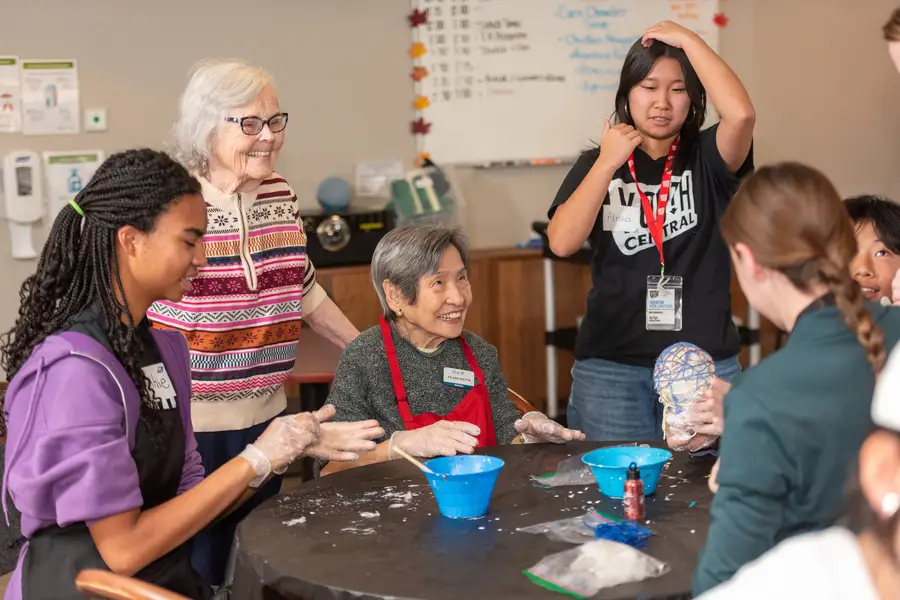
David attended Club 36 for about three years, and by Isabella's account, it was wonderful for him. "The staff are so well trained, so friendly and caring, and they would meet him where he was at, in that moment" she said. What started as one day a week grew into two. He took part in cooking activities, which delighted him, since he had always loved food. He even started painting, something he had never done in his life before.
He would come home from Club 36 with a detailed rundown of whatever he'd eaten that day. He genuinely loved it there. The irony wasn't lost on Isabella that he'd be so animated about his day out, and then show little interest in doing anything once he was home. But she treasured the glimpses of his spark, and the few precious hours to herself while he was there, even if she often spent that time visiting her own mother, who lives in care as well.
David recently moved into a care facility. Isabella had reached the point where she could no longer meet his needs safely at home. David doesn't fully understand the changes happening in his brain, and he doesn't feel he belongs where he is. He looks at the people around him and sees people who he can’t relate to. Isabella can see that he struggles without her by his side to help him make even simple everyday decisions.
Isabella visits him every day, for hours at a time. It leaves her very little space for herself, and she carries a heavy, complicated guilt about that: guilt if she stays away too long, guilt if she imagines ever travelling again, guilt for wanting a life of her own.
She leans hard on her faith, which she has been actively working to deepen, and on the people around her: friends, family, and a support group of women who meet regularly, all caring for husbands at different stages of dementia. Even that community isn't simple, though. "Sometimes I get dementia'd out," she admitted. "I get tired of it being the only thing I ever talk about. It's hard, sometimes, to listen to other people's stories, when mine already feels like it's all-encompassing."
Lately, Isabella has been trying to find her way back to herself. She joined a game league this past winter with her daughter, at a local cultural club, and next year's league will include an even bigger family team. This past summer, a community event turned into an unexpectedly joyful family afternoon with Isabella’s extended family joining in the games. Isabella still calls it "ridiculously fun."
She's also returning to her roots. Born in Italy and raised there until she was a young child, she's brushing up on her Italian through an online course her children gave her as a gift, with hopes of eventually joining conversation groups at the cultural centre. She's deepening her faith through reading. And she still dreams of travel; someday, a return to Italy.
Isabella grieves, openly and without apology, the life she thought she'd have with David. Their second chance at love began with so much promise: adventure, purpose, a shared excitement for whatever came next. Instead, dementia has quietly rewritten most of the years since. As she gets older herself, she feels time slipping away, and a sense that so much of her life has been steered by a disease rather than by her own hands.
And yet, she keeps building a life. Bocce with her grandchildren. Italian lessons. Her faith. Small, deliberate acts of joy, carved out alongside the grief.
“I am grateful for the support of people who want to help our family with this journey, and for the resources that are available. I know I’m not alone, even if it feels that way sometimes. The support is out there; you just have to reach for it.”